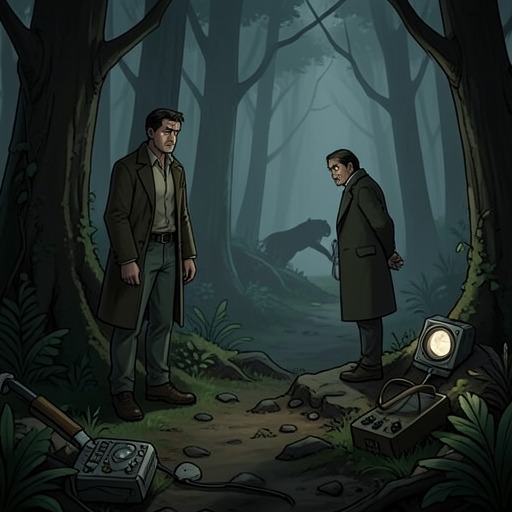
Idées suicidaires de Julien
Mon Loup Alpha“Idées suicidaires de Julien” names the crisis that opens Julien’s story: after another painful rejection, he stands on the roof of his Montréal apartment building intending to die. The thought is specific, immediate, and checked only by his fear of suffering. His movement away from that edge is not shown as a clinical recovery. Instead, attention shifts to the injured Nemrod, first through Julien’s professional duty as a nurse and then through an intense attachment that gives him a new reason to act. By the ending, Julien has redirected his energy toward helping Nemrod in a clan war, while the narrative leaves the durability of that change uncertain.
Background and Trigger
Julien’s crisis follows a recent move from Orlando to Montréal. He had left behind what he describes as a bleak routine as a nurse, hoping to begin again, but the new city has not yet become a place of belonging. He has been there only a week when he seeks a date through a gay dating site, hoping to meet someone who might become a boyfriend. The person he meets, Tyler, is a literature student at Université Concordia. Their conversation and laughter initially seem promising, but when Julien takes Tyler’s arm in the cold and Tyler does not respond, Julien reads the gesture as evidence that the interest is not mutual. Tyler leaves well before the time they had planned to spend together, offering a work-related excuse. For Julien, this is another instance in a repeated pattern of dates ending in rejection, not an isolated disappointment.
The move has also left him socially and linguistically exposed. Julien says that he is lonely in a city whose official language is French, which he does not speak well after only two semesters of intermediate study. On his first night in Montréal he went through the Village and passed several clubs, including the Apollon, Unity, and Sky Complex, but did not want a night of partying. At the Campus, a dancer offered a three-minute lap dance for twenty dollars; Julien declined and left. What he wanted, he insists, was affection and a boyfriend, not a paid or fleeting substitute. These experiences sharpen the distinction between being approached and feeling wanted by someone he desires.
The Rooftop Crisis
On a cold winter night, Julien stands on the roof of the low apartment building where he lives on Papineau Avenue. He imagines falling headfirst onto the road below, among cars whose drivers seem as indifferent as the traffic itself. His thoughts extend to what his body might endure after the fall, but the anticipated pain stops him from acting immediately. This is the decisive restraint in the scene: not a recovered hope or a newly discovered support network, but fear of physical suffering.
The setting intensifies the sense of isolation. Julien watches Montréal’s lights and experiences one of the season’s first snowfalls; cold flakes move across his reddened face as the wind strikes him. He describes loneliness not as an abstraction but as a pain that becomes physical. His mind narrows around repeated romantic failure and the possibility of death, while the city around him appears bright, busy, and emotionally unreachable. The contrast makes the rooftop both a literal threshold and a measure of how little connection Julien feels he has found since arriving.
Care as an Interruption
After the rooftop crisis, Julien’s encounter with Nemrod brings a different demand on his attention. Nemrod is injured and has said that the unusual green substance from his wound is blood, a claim that leaves Julien certain he has not been told everything. Even so, Julien acts from his nursing training: he recognizes that the wound needs cleaning and may need stitches, retrieves sterile dressings and gauze from his medical kit, and prepares to treat him. He explicitly understands care as his professional responsibility. The shift matters because it directs him outward, toward a person whose immediate danger requires action, rather than keeping him alone with the thoughts that brought him to the roof.
Julien’s attention to Nemrod is not exclusively professional. He feels attraction, notices Nemrod’s appearance, and has to pull himself away from his fantasies because a man’s life is at risk. Those impulses coexist with the practical work of bringing the injured man inside and tending to him. The narrative thus places responsibility beside desire rather than presenting Julien as simply cured by a romantic encounter. His care begins as a concrete response to injury; it becomes entangled with the intimacy and extraordinary bond that follow.
Attachment and Redirection
After recovering, Nemrod approaches Julien and embraces him. Later, Nemrod’s gestures and words define Julien as his companion, while the act of marking and the exchange of scents give the bond a bodily and sensory dimension. Julien accepts the claim willingly, although he does not understand what the companion status means. His readiness to belong to Nemrod contrasts with the rejection and loneliness that had occupied his thoughts on the roof. Nemrod’s kiss becomes, in Julien’s own understanding, a return of passion and vitality after a life that had felt empty.
That sense of being alive redirects Julien toward a future, but the future is bound to Nemrod’s conflict rather than to a broader plan for support or safety. When Julien wakes and finds Nemrod gone, he does not want to wait passively; he wants to stand beside him. Seeing couples walk hand in hand, he decides that love means supporting the person one loves, and resolves to help Nemrod win his clan war. The ending therefore marks a significant change in Julien’s immediate orientation: the man who had stood alone above an indifferent street now chooses an active alliance. It does not confirm that his suicidal thoughts have ended permanently. Their apparent displacement by romantic attachment and a dangerous communal struggle leaves an important uncertainty at the center of the state’s trajectory.